Tuesday, May 15, 2012

Our Industrial Paint Division is "Having a Blast!"

Our industrial paint division is in the process of beautifying a 6 million gallon steel water tank in the northern suburbs. This is the largest size potable water tank in the state of Illinois.  Our scope of work involves abrasive blasting of the interior steel of the tank and then coating the interior and exterior of the tank.  Our industrial paint crew is off to a great start with their safety performance. There is a lot that goes into the planning and implementation of safety on a project of this nature. Some of the safety aspects of the project involve ventilating the interior of the tank, monitoring the air, our crew wearing air-supplied helmet respirators, protective gloves, hearing protection, protective clothing, safety cables on all the blast hoses, a dust collector system, fall protection while working on the tank roof top, aerial lift safety, etc.  Below are a couple of photos & a video showing how it's done!  Great job crew; keep up the safety performance.    


Monday, May 7, 2012

Today’s Safety Topic: Communication & Job Rotation!


Communication among each other can prevent many injuries especially those of a repetitive nature.  All employees need to communicate with their supervisors if they are developing pain in their shoulders, elbows, wrists, knees, back, etc., from performing a specific task over and over.  These types of problems can be prevented from turning into an injury.  If you are noticing signs that your body is getting fatigued from doing a repetitive task over and over, your body probably just needs a break from that specific task which is causing the pain.  The preventative measure in this case to alleviate the pain and to keep the pain from becoming an injury could be as simple as job rotation.  Once the employee reports to his/her lead supervisor that he/she is developing pain in a specific body part from performing a repetitive task, the lead supervisor should then discuss this with their Superintendent and develop a plan to change that employee’s duties for a period of time to give that body part a break.  This simple procedure of job rotation will typically prevent the pain from becoming an injury.  If a supervisor knows ahead of time of a repetitive task that will go on for a long period of time, an idea would be to have a couple of employees trained to perform the task and rotate the employees out every couple hours, days or as needed to help reduce the risk of an injury.    
  
If not for yourself, be safe for your family and loved ones.
  
Should you have any questions regarding this topic, you are encouraged to discuss this with your lead supervisor, Superintendent our call our Safety Director, Peter Graham at (847) 417-1689.


Friday, April 27, 2012

Stair Safety - Stair Treads (not filled in)!

You will eventually come across this at a job site.  You have work on multiple floors and the stairs are installed, however the treads are not filled in.  What should you do? 
First of all, you cannot walk on or use stairs in this condition.  The treads need to be appropriately filled in.  They should either be temporarily filled in usually with wood or sometimes Styrofoam or permanently filled in with concrete.  Either way, until the treads are filled in, they are a trip and fall hazard.  If the stairs are filled in with temporary measures, you need to ensure that the temporary fill is even and level and still does not pose a trip and fall hazard. 

If you come across a stairwell that has stair treads that are not filled in, you should do the following:  Notify your lead supervisor of the hazard.  The lead supervisor should in turn notify the general contractor of the hazard so that measures can be taken to fix the hazard.  All of our employees need to be made aware of the hazard and notified to not use the stairs until the treads are appropriately filled in and the stairs have been determined as safe to use.  The stairwell should then be closed down as soon as possible.  It is not necessarily your responsibility to close the stairwell, however, it is your responsibility to stay off the stairs and to notify your lead supervisor so that safety measures can be implemented.  “Stairwell Closed” signs and barricades shall be installed at all levels of access to the stairs.  Caution tape alone is not considered a good safety measure as many people tend to just walk under the caution tape and not pay much attention to it. 

Many employees may be tempted to use the unsafe stairs as they are right there in front of them.  They say to themselves, “I will only be on the stairs for a minute and no one will see me.”  This is why the stairs need to be closed down, so that no one is tempted to use them.  If an I.D.I. employee is found using stairs with the treads not filled in, that is an unsafe act and the employee shall be issued a written safety warning for his/her own safety. 

Also, all employees should be informed of how they should access the other floors.  Is there another set of stairs that have been completed?  Is there ladder access to the other floors? 

Thursday, April 19, 2012

Next Quarterly Safety Meeting – June 2nd!


Good morning to all I.D.I. employees:  All employees are invited to attend our 2nd quarterly safety meeting for 2012 which will be held on Saturday, June 2nd from 7:00am to about 9:00am.  The safety training topic will be on Supported Scaffold Safety.  The meeting will be held at our office location in the warehouse at 28059 W. Commercial Ave., Barrington, IL 60010.  We last trained on scaffolding at our May, 2008 quarterly safety meeting so it’s time for a refresher for the veterans and maybe some new safety training for the new hires.

According to the Bureau of Labor Statistics, 2.3 million people work on scaffolding annually.  There are over 10,000 scaffold related injuries on average per year.  There has been an average of 88 scaffold related fatalities over the past 5 years.  Scaffold ranks #2 as the most frequently cited construction OSHA standards with 7,069 citations being issued in 2010.  We want to provide scaffold safety training so that you don’t become one of these statistics.  We want for all of our employees to live up to our safety mission statement which is: “Everyone Goes Home Alive and in the Same Condition as They Arrived; Your Loved Ones Count On It!”  And that is why we are providing scaffold safety training.   

We encourage everyone to attend for several reasons of which the most important reason is for your safety. 
We look forward to seeing you on June 2nd.  Should you have any questions regarding scaffold safety or the upcoming meeting, please call our Safety Director, Peter Graham at (847) 417-1689.  

Have a Safe Day!

Wednesday, April 11, 2012

PPE - Your Last Line of Defense!

PPE stands for personal protective equipment.  PPE is your last line of defense against injuries so it is important that you wear it.  Just a couple of PPE reminders for all employees to keep in mind to help fight the battle against injuries.  We feel that safety starts with the hard hat.  We liken it to getting in your car and fastening your seat belt.  Head protection can save your life. 
Hard hats are required 100%.
Work boots are required 100%
Long pants and shirts with sleeves are required 100%.  No tank top style shirts allowed. 
Eye protection – ANSI Z87.1 approved safety glasses or goggles must be worn when required by the general contractor.  They must also be worn when the tool or process you are doing requires eye protection.  Examples of tools and processes that you might use that require eye protection are TrakFast guns, staple guns, saws, welding, handling insulation, etc.  We cannot name every tool or process that might take place.  You must follow the tool manufacturer’s safety recommendations for eye protection.  You should also wear eye protection when drilling overhead, sanding overhead, when using corrosive liquids or corrosive paints and when the Material Safety Data Sheets (MSDS) requires them to be worn.  Other times you might wear safety glasses are when it’s windy outside, as dust and debris can get in your eyes.
Dust Mask type respirators are to be worn by employees performing sanding operations and when handling insulation.  Voluntary use in dusty conditions. 
Half Mask and/or Full Mask organic vapor respirators are required to be worn by painters when performing any spray type applications.  Also required with some painting products when not spraying.  Painters must refer to the MSDS to determine if an appropriate respirator is required for the product they are using.  If you are unsure, then seek assistance from your Foreman, Superintendent or our Safety Director.  Painters or anyone wearing a half or full mask respirator must have been fit tested, trained and medically approved to wear these types of respirators. 
Gloves – required when handling insulation.  Nitrile coated or dipped gloves required when handling Thermafiber type insulation.  Rubber type PVC coated gloves are required when handling corrosive type liquids.  All employees working with unfamiliar products need to review the MSDS for the products you are using to check the glove requirements.  Gloves are required for carpenters/framers and all employees handling or working around sharp objects.  Your Superintendent has the authority to require gloves and other PPE as deemed necessary for your protection.
Hearing Protection is required when noise levels exceed OSHA acceptable levels.   Examples of when to use hearing protection would be when you are working next to someone who is jack hammering, when you are using a chopsaw to cut steel studs for an extended period of time, when the work environment has unusually high noise levels, etc. As always, you should check the operator’s manual of the various power tools you are using for the hearing protection requirements.
Face Shieldyou must always were safety glasses under a face shield.  Face shields are required when ever using a gas partner saw.  Face shields shall be worn whenever a tool or process requires one to be worn.  Examples of situations when a face shield should be worn are when sparks are flying toward you while cutting steel, when there is a chance debris could strike you on the face or eyes.  You should refer to the tool operations manual for the tool you are using to see if a face shield is required.

This article does not name every situation in which you would be required to wear PPE, however, the above is a good start.  Don't wear PPE just because you are required to; wear PPE because it's your last line of defense against injuries.  Wear PPE for the sake of your loved ones who count on you coming home from work alive and in the same condition as you arrived. 

Should you have any questions regarding PPE, you are encouraged to call our Safety Director, Safety Pete at (847) 417-1689.

Have a Safe Day!

Monday, April 2, 2012

Green Tape on All 3-Pronged Electrical Tools & Extension Cords!

Good afternoon to all I.D.I. employees:  All Safety Coordinators should have been provided a roll of green electrical tape last week from your Superindendent.  We began a new quarter on 4/1/12 for our Assured Grounding Program.  You are to inspect, test and color-code with green tape all 3 pronged electrical tools and extension cords.  All electrical tools and cords need to be visually inspected.  If you see any defects in the cords such as bare wires, severe kinks, missing or damaged ground prong, the cord pulling away from the plug end housing, etc., then that tool or cord would need to be immediately removed from service and reported to the lead person.  If your tool/cord passes the visual inspection, your next step is to test the cord with a receptacle tester.  First, you should test the oulet that you will be plugging your cord into to ensure that it is properly wired.  You should see 2 yellow lights lit up on your tester and the red light should be off.  This means the outlet is working appropriately.  Next, plug your cord into the outlet and then test the cord with the receptacle tester.  Again, you should see the same light pattern as mentioned above and this would mean the cord passed the test and it is good and safe to use.  Any other light pattern means that there is a problem with the cord and the cord needs to be removed from service and reported to your lead person.  If the cord passes the visual inspection and the cord tester test, you should then remove the previous quarter's white electrical tape and install the green electrical tape about 1" down from both plug ends.  Your cord is now in compliance with our 2nd quarter's Assured Ground Program.  The green tape shall remain in place from 4/1/12 through 6/30/12.  You are not quite done yet!  You now need to visually inspect all electrical cords and tools on a daily basis and if any defects are found, the cord needs to be immediately removed from service.  Thank you for taking the time to ensure your electrical tools and cords are in safe working order.  Your actions may prevent one of our family members from sustaining an electrical shock type injury or worse yet and electrocution.  If you have any questions regarding our Assured Grounding Program, please call our Safety Director, Peter Graham, at (847) 417-1689. 
Have a Safe Day!

Tuesday, March 27, 2012

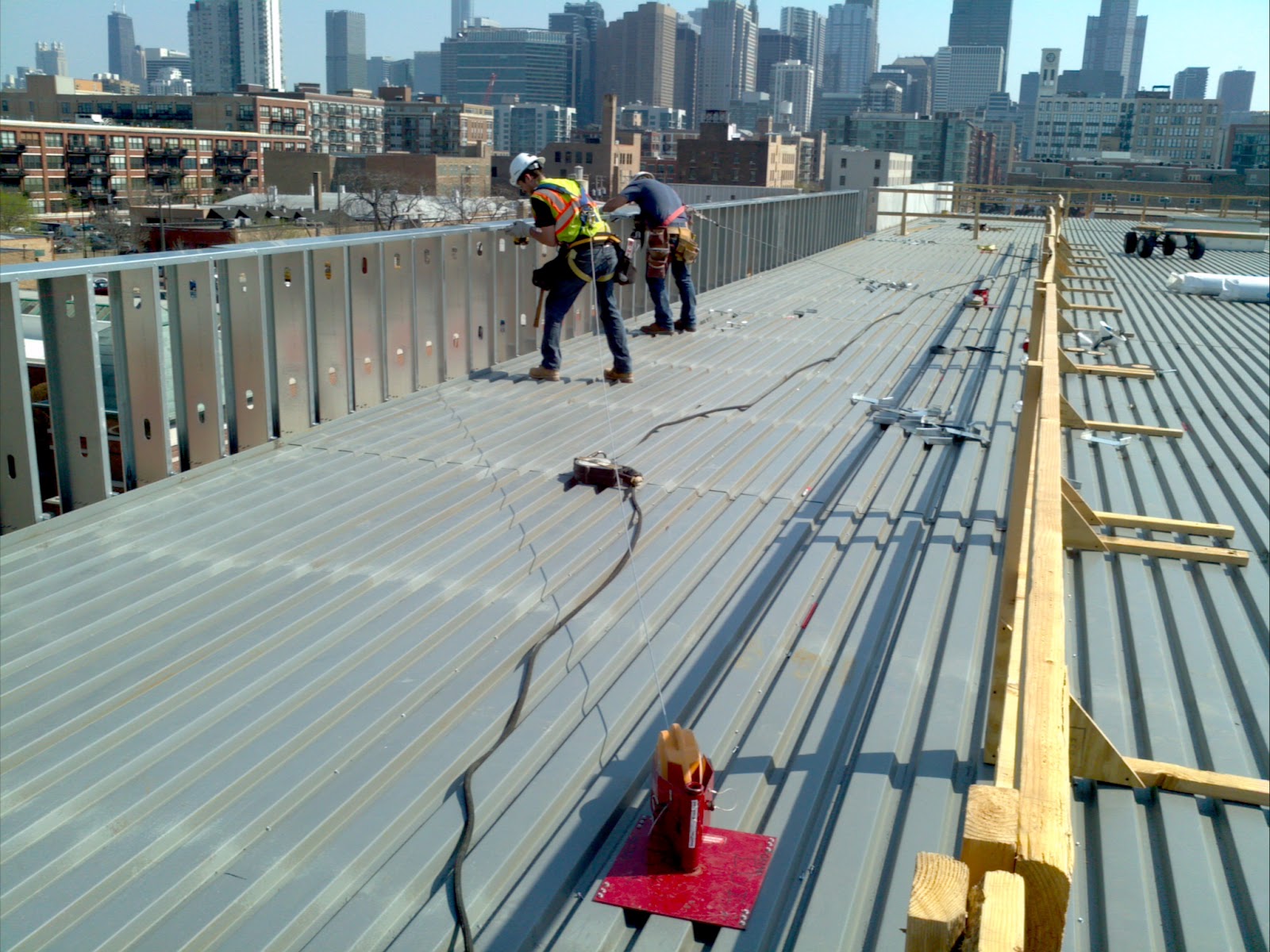
How to Safely Use Our - Metal Pan Roof Anchors!

We often use metal pan roof anchors as our fall arrest anchorage tie off point when there are no other 5,000 lb fall protection anchorage points in our work areas when working on metal pan decking.  The metal pan roof anchors are designed and engineered as a 5,000 lb anchorage point but will only work as one when used correctly. 

The metal pan roof anchors are designed for 1 person to attach to.  You cannot tie off more than one person to a metal pan roof anchor.  Depending on the model, there are either 12 holes or 16 holes on the flat plate of the device.  You are required to use #12 1 ¼” tech bolts to secure the metal pan roof anchor to the metal pan decking.  You cannot use a substitute screw or bolt as they may not hold you should you fall.  You must fill all 12 or 16 holes with a tech bolt and all of the tech bolts must fasten to the metal pan decking.  If you insert a tech bolt through one or more of the holes and it does not fasten to the metal pan decking, then you need to adjust the base of the metal pan roof anchor so that it does.  Also, it is critical to keep an eye on your tech bolts to ensure they are not stripped or corroded.  Inspect your tech bolts everyday and replace them if you see any signs of wear.

Also, the metal pan roof anchors are only allowed to be used with a retractable lanyard.  You cannot tie off to a metal pan roof anchor with a regular lanyard or a lifeline.  The metal pan roof anchors are designed and engineered to arrest a falling person who is secured to it with a retractable lanyard only. 

Should you have any questions regarding this matter, please contact our Safety Director, Peter Graham. 
Have a Safe Day!