Good morning Safety Coordinators: Today is Monday which means it's that time of the week to perform a weekly job site safety inspection and to perform a meaningful toolbox talk with our employees around 9:45am. Let's start the week off on the right foot for the benefit of our employees. Some time between 7:00am and 9:00am this morning, all Safety Coordinators should grab a safety inspection form from your Safety Coordinator manual and walk your job site and look for hazards. Any hazards found should be documented on your safety inspection form and comments about the hazard and plan to protect our employees from the hazard should be documented. Then after your morning break, at 9:45am, the Safety Coordinators should gather the crew and perform a toolbox talk that is pertinent and meaningful to the tasks being performed, the equipment being used or to something that pertains to safety at your job site. Then after the toolbox talk has been completed, have all the employees at the project that participated in the toolbox talk sign the toolbox talk roster. Finally, the Safety Coordinator should advise the employees of any hazards found during the walk around safety inspection and what our plan is to abate the hazard and to protect the employees from the hazard. If a hazard is identified that cannot be abated immediately, you should then contact our Safety Director, Peter Graham, to discuss it so we can implement a plan to abate the hazard. After the above is completed, please do your best to get the toolbox talk sign in roster & safety inspection form turned in to our Safety Department no later than Friday, 6/14/13. Lets make it a goal to get 100% of the toolbox talks rosters and safety inspection forms turned in by Friday. If you have any questions, please contact our Safety Director, Peter at (847) 417-1689 or you can e-mail him at pgraham@4idi.com.
Thank you for helping us to prevent injuries to our employees. Go Hawks!
Monday, June 10, 2013


Wednesday, May 22, 2013
From the "I Caught You" Series
At International Decorators, we have a habit of catching our employees performing safely! Below are a few action shots of our employees being caught in action performing in a safe manner or showing something they did for the safety of our employees.
Great job everyone! You are helping us to live up to our safety mission statement which is:
Great job everyone! You are helping us to live up to our safety mission statement which is:
"Everyone Goes Home Alive and in the Same Condition as They Arrived; Your Loved Ones Count On It."
 |
| This stairwell scaffold was built like a tank by Keith Rehn. Wall to wall 3/4" plywood decking on top of 6 aluminum planks, etc. Great job - Keith! |
 |
| Same scaffold, just another view |
 |
| One last view of the same scaffold from underneath |
 |
| Can I build a scaffold or what! Great job - Keith! |
 |
| Salvador Rodriguez, taping walls in a safe manner and wearing the correct PPE for the job. This guy is so confident with his taping abilities that he wears a $200.00 shirt while taping as he knows all the mud is going on the wall only. |
 |
| A couple of I.D.I.'s finest performing housekeeping and game planning. Great job also with wearing the appropriate PPE - Joe Vess, Cesar Chavez and Jaime Martinez |
 |
| Taper, Fernando Rodriguez tying off with fall arrest equipment while working in an elevator shaft. Is this guy ever not smiling? Great job - Fernando! |
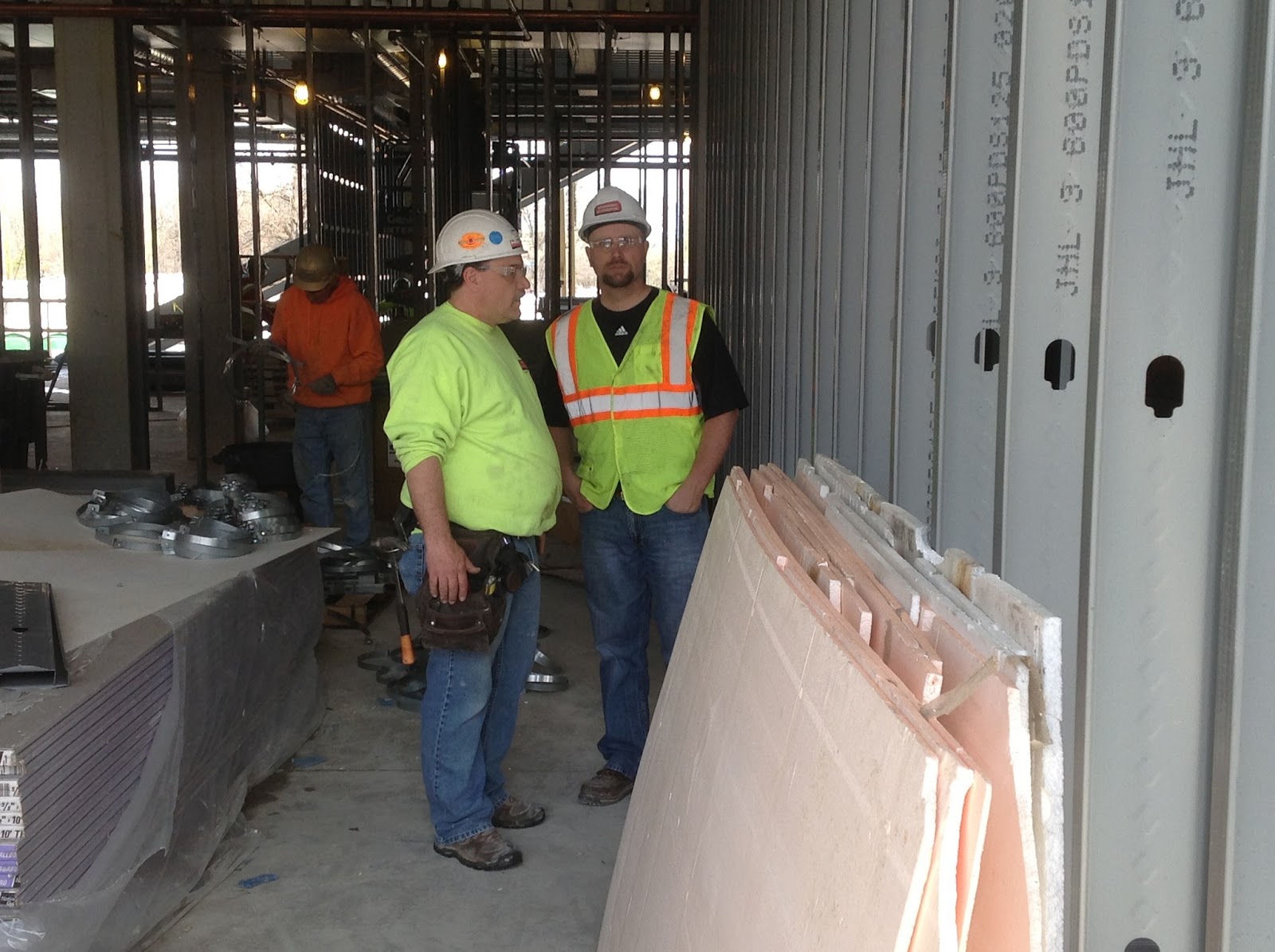 |
| Lead Interior Framing Supervisor, Dan Hilt & Superintendent, Brian Haese - Doing some serious thinking & planning at the O.C.C. project. While doing so, they are wearing the appropriate PPE for a construction project. Great job - gentlemen! |
Tuesday, May 14, 2013
National Electrical Safety Month: Six Safety Tips for Working Near Overhead Power Lines!
In honor of National Electrical Safety Month this May, spark a safety-conscious conversation by sharing these six tips for working near overhead power lines.

It was just a typical day at work. Gary Norland and his coworkers were discussing weekend plans as they worked near overhead power lines. But when Norland leaned back and came into contact with 12,500 volts of electricity, he suffered life-changing burns the required a 4-month hospital stay and more than 50 surgeries.
Now, 20 years after the accident, Norland has a message: “If you get injured, it's an impact that's going to affect everybody.”
During National Electrical Safety Month this may, Norland and his family are working with Safe Electricity's “Teach Learn Care TLC” campaign to help prevent others from having accidents with overhead power lines and to keep other families from having to go through such a tragic experience.
“Those small shortcuts will add up to that big one, and then everything is going to change," Norland explained. “Take the time, and do it right the first time. Make sure you do everything safe.”
Safe Electricity, a public awareness program of the Energy Education Council (EEC), offers the following six tips for those who may be near overhead power lines when working outside:
- Look up and around you. Always be aware of the location of power lines, particularly when using long tools like ladders, pool skimmers, and pruning poles. Be especially careful when working near power lines attached to your house. Keep in mind that wind can blow large objects out of your control.
- Keep equipment and your body at least 10 feet from power lines. Even if you do not come in contact with a power line, the electricity can arc to nearby objects and people.
- Be careful when working on or around your roof. That includes installing or cleaning gutters, installing rooftop antennas and satellite dishes or doing repair work. Never use water or blower extensions to clean gutters near electric lines. Contact a professional maintenance contractor.
- Never climb trees near power lines.
- Never trim trees near power lines. Leave that to the professionals.
- Always follow safety procedures, no matter how boring and mundane they seem.
“We are grateful that Gary and his family are willing to share their difficult experience to help prevent other tragic accidents," said Molly Hall, executive director of the Safe Electricity program. “We encourage everyone to visit SafeElectricity.org to see the video of Gary's story and learn more about staying safe around overhead power lines.”
Citation: The above article is from EHS online magazine and the author is Laura Walter, 5/13/13.
Have a Safe Day!
Friday, May 3, 2013
100% Attendance at our Painters & Tapers Only Quarterly Safety Meeting!
As most of you know, we held a volunteer quarterly safety meeting on April 20th for the painters and tapers only. The safety training topics included respirator training, fit testing on the respirators and stilt safety. We wanted to report out to everyone that for the first time since we began tracking the attendance, we had a 100% show-up rate.
We hope that the safety training session was beneficial to everyone in attendance. We had excellent participation and questions during the session. We want to thank all of you for taking time out of your busy lives for the sake of your safety. The main reason we provide safety training is because of you and our company's safety mission statement - "Everyone Goes Home Alive and in the Same Condition as They Arrived; Your Loved Ones Count On It."
During the meeting, we also celebrated the story of our employees that saved a plumber's life. We had a crew working at a downtown tenant space on 4/12/13 and a plumber suddenly dropped to the ground. He was unconscious and at times, not breathing. Our very own employees, Gabe Macias and Tom Gracyk immediately began performing CPR on the plumber. Also assisting in the emergency situation was Jim Woods, Paul Baca, Joe Bellich, Rick Rizzi and Randy Francisco. In the end, we found out that the plumber had a massive heart attack. He has had bypass surgery and we were told that he is doing well. We were also informed that our employees saved his life. The CPR kept him alive until the paramedics arrived! What an awesome team effort and great work under some extreme pressure!
What about you? Are you trained on CPR? Are you prepared to save a life? Will you be ready to step in when someone literally needs you to save their life? If you have not been trained in CPR, please contact Safety Pete at 847/417-1689 and he could provide you with information on how to get trained in CPR or contact your union to obtain this training. Below is the contact information for your respective unions:
Below is a video from the quarterly safety meeting celebrating the story! Below that is another video showing the painters being fit tested on their respirators by Luis Moctezuma of 3M and some photos taken during the safety meeting.


We hope that the safety training session was beneficial to everyone in attendance. We had excellent participation and questions during the session. We want to thank all of you for taking time out of your busy lives for the sake of your safety. The main reason we provide safety training is because of you and our company's safety mission statement - "Everyone Goes Home Alive and in the Same Condition as They Arrived; Your Loved Ones Count On It."
During the meeting, we also celebrated the story of our employees that saved a plumber's life. We had a crew working at a downtown tenant space on 4/12/13 and a plumber suddenly dropped to the ground. He was unconscious and at times, not breathing. Our very own employees, Gabe Macias and Tom Gracyk immediately began performing CPR on the plumber. Also assisting in the emergency situation was Jim Woods, Paul Baca, Joe Bellich, Rick Rizzi and Randy Francisco. In the end, we found out that the plumber had a massive heart attack. He has had bypass surgery and we were told that he is doing well. We were also informed that our employees saved his life. The CPR kept him alive until the paramedics arrived! What an awesome team effort and great work under some extreme pressure!
What about you? Are you trained on CPR? Are you prepared to save a life? Will you be ready to step in when someone literally needs you to save their life? If you have not been trained in CPR, please contact Safety Pete at 847/417-1689 and he could provide you with information on how to get trained in CPR or contact your union to obtain this training. Below is the contact information for your respective unions:
Painters District Council #30: www.paintersdc30.com
630/377-2120
Chicago
Carpenters: www.chicap.org 847/364-8367
We urge you to be prepared like Tom & Gabe are! Don’t forget to give
your family an extra hug & kiss tonight!
Below is a video from the quarterly safety meeting celebrating the story! Below that is another video showing the painters being fit tested on their respirators by Luis Moctezuma of 3M and some photos taken during the safety meeting.
 |
| I.D.I.'s President, Butch - demonstrating how in the old days, some employees would wear a dust mask and punch a hole in it so they could smoke a cigarette. This was obviously not condoned at the time and no one does this anymore! |


Friday, April 26, 2013
Type of Respiratory Protection for Lacquer Paint Applications!
As you all know, we had a volunteer quarterly safety meeting on Saturday, 4/20/13 with our painters and tapers and the main topic of the meeting was respiratory protection. During the meeting we were discussing respirator cartridge filters, the types to use and when to use them, etc. One of our very fine painters,Vito Rizzi asked the following question: "What type of cartridge filter should be used for applying lacquer type paints." We encourage these types of questions as we can all learn from them. So first of all, thank you, Vito, for asking the question. According to the material safety data sheets and according to 3M, which is our respirator cartridge filter provider, the correct cartridge filter to use for lacquer paints is the organic vapor cartridges. These are the black labeled cartridges that we are already using for our common paint spray applications. These black labeled organic vapor cartridges are the correct respirator filters to use for most paint applications. They are used for latex, lacquers, enamels, most epoxy's, solvents and many other varieties of paints. Applications that would typically require a different type of cartridge filter other than the black labeled organic vapor cartridge are ammonia, acids, chlorine, etc. The material safety data sheets will typically tell you the type of cartridge filter to use. The MSDS will typically say to use an organic vapor cartridge which is the black labeled one. If you are reviewing an MSDS sheet and it says to use a cartridge other than an organic vapor cartridge, then I would advise you to contact our Safety Director, Peter Graham. I (Peter) am always reviewing the MSDS sheets when we are using a new product that we are not familiar with. If we provide a paint product that calls for a different type of respirator cartridge filter, we would notify our paint crew that will be using the product and provide them with the correct cartridge filter.
I hope this answers the question. As always, please contact our Safety Director, Peter Graham with any safety related questions.

I hope this answers the question. As always, please contact our Safety Director, Peter Graham with any safety related questions.
Have a Safe Day!
Friday, April 12, 2013
Reminder - Quarterly Safety Meeting, Saturday, 4/20/13 Painters & Tapers Only!
International Decorators put out a memo on 2/5/13 advising that we would no longer be holding volunteer quarterly safety meetings. The reason being is that we were contacted by the Chicago Carpenters Union and they demanded that if we hold our meetings, we must pay our employees for attending these training sessions plus pay all contributions into the fringe benefit funds. This makes our quarterly safety meetings cost prohibitive.
We are currently working on plans to ensure that all of our employees continue to receive safety training. In the meantime, we contacted District Council #30 & #14 (painters & tapers unions) and they have given us their permission to continue to offer our quarterly safety training meetings. With that being said, we are holding our 1st quarterly safety meeting for 2013 on April 20th. This meeting will be held for painters and tapers only.
If you are a painter or taper employee for International Decorators, you are invited to attend our quarterly safety meeting on Saturday, April 20, 2013 from 7:00am to about 9:00am. The safety meeting will be held at our office location in the warehouse at 28059 W. Commercial Ave., Barrington, IL 60010. The meeting topics will be on respirator safety including fit testing and safe stilt usage.
Painters (and tapers that have a respirator for 3M Fire Dam applications) – please ensure that you come to the meeting clean shaven in the areas where the respirator seal comes into contact with your face. Also, please ensure that you bring your ½ mask respirator with you and your full mask respirator if you have one as you will be fit tested on them.
We look forward to seeing you on April 20th. Should you have any questions regarding the upcoming meeting, please call our Safety Director, Peter Graham at (847) 417-1689.
Thursday, April 4, 2013
Seven Common Causes of Incidents!
Good afternoon to all I.D.I. employees: The following is a toolbox talk from the Construction Safety Council's website in regards to the common causes of accidents and injuries. This serves as a good reminder and as a tool to use in our battle against injuries.
Consider this statistic: 80 out of every 100 incidents are the fault of the person involved in the incident. Unsafe Acts cause four times as many incidents & injuries as unsafe conditions. Incidents occur for many reasons. In most industries people tend to look for "things" to blame when an incident happens, because it's easier than looking for "root causes," such as those listed below. Consider the underlying incident causes described. Have you been guilty of any of these attitudes or behaviors? If so, you may have not been injured; but next time you may not be so lucky.
• Taking Shortcuts: Every day we make decisions we hope will make the job faster and more efficient. But do time savers ever risk your own safety, or that of other crew members? Short cuts that reduce your safety on the job are not shortcuts, but an increased chance for injury.
• Being Over Confident: Confidence is a good thing. Overconfidence istoo much of a good thing. "It'll never happen to me" is an attitude that can lead to improper procedures, tools, or methods in your work. Any of these can lead to an injury.
• Starting a Task with Incomplete Instructions: To do the job safely and right the first time you need complete information. Have you ever seen a worker sent to do a job, having been given only a part of the job's instructions? Don't be shy about asking for explanations about work procedures and safety precautions. It isn't dumb to ask questions; it's dumb not to.
• Poor Housekeeping: When clients, managers or safety professionals walk through your work site, housekeeping is an accurate indicator of everyone's attitude about quality, production and safety. Poor housekeeping creates hazards of all types. A well maintained area sets a standard for others to follow. Good housekeeping involves both pride and safety.
• Ignoring Safety Procedures: Purposely failing to observe safety procedures can endanger you and your co-workers. You are being paid to follow the company safety policies-not to make your own rules. Being "casual" about safety can lead to a casualty!
• Mental Distractions from Work: Having a bad day at home and worrying about it at work is a hazardous combination. Dropping your 'mental' guard can pull your focus away from safe work procedures. You can also be distracted when you're busy working and a friend comes by to talk while you are trying to work. Don't become a statistic because you took your eyes off the machine "just for a minute."
• Failure to Pre-Plan the Work: There is a lot of talk today about Job Hazard Analysis. JHA's are an effective way to figure out the smartest ways to work safely and effectively. Being hasty in starting a task, or not thinking through the process can put you in harm’s way. Instead, Plan Your Work and then Work Your Plan!
Consider this statistic: 80 out of every 100 incidents are the fault of the person involved in the incident. Unsafe Acts cause four times as many incidents & injuries as unsafe conditions. Incidents occur for many reasons. In most industries people tend to look for "things" to blame when an incident happens, because it's easier than looking for "root causes," such as those listed below. Consider the underlying incident causes described. Have you been guilty of any of these attitudes or behaviors? If so, you may have not been injured; but next time you may not be so lucky.
• Taking Shortcuts: Every day we make decisions we hope will make the job faster and more efficient. But do time savers ever risk your own safety, or that of other crew members? Short cuts that reduce your safety on the job are not shortcuts, but an increased chance for injury.
• Being Over Confident: Confidence is a good thing. Overconfidence istoo much of a good thing. "It'll never happen to me" is an attitude that can lead to improper procedures, tools, or methods in your work. Any of these can lead to an injury.
• Starting a Task with Incomplete Instructions: To do the job safely and right the first time you need complete information. Have you ever seen a worker sent to do a job, having been given only a part of the job's instructions? Don't be shy about asking for explanations about work procedures and safety precautions. It isn't dumb to ask questions; it's dumb not to.
• Poor Housekeeping: When clients, managers or safety professionals walk through your work site, housekeeping is an accurate indicator of everyone's attitude about quality, production and safety. Poor housekeeping creates hazards of all types. A well maintained area sets a standard for others to follow. Good housekeeping involves both pride and safety.
• Ignoring Safety Procedures: Purposely failing to observe safety procedures can endanger you and your co-workers. You are being paid to follow the company safety policies-not to make your own rules. Being "casual" about safety can lead to a casualty!
• Mental Distractions from Work: Having a bad day at home and worrying about it at work is a hazardous combination. Dropping your 'mental' guard can pull your focus away from safe work procedures. You can also be distracted when you're busy working and a friend comes by to talk while you are trying to work. Don't become a statistic because you took your eyes off the machine "just for a minute."
• Failure to Pre-Plan the Work: There is a lot of talk today about Job Hazard Analysis. JHA's are an effective way to figure out the smartest ways to work safely and effectively. Being hasty in starting a task, or not thinking through the process can put you in harm’s way. Instead, Plan Your Work and then Work Your Plan!
"It is better to be careful 100 times than to get killed once." (Mark Twain)
Have a Safe Day!
Subscribe to:
Posts (Atom)